World to hit 1.5°C warming a decade early, Europe warns
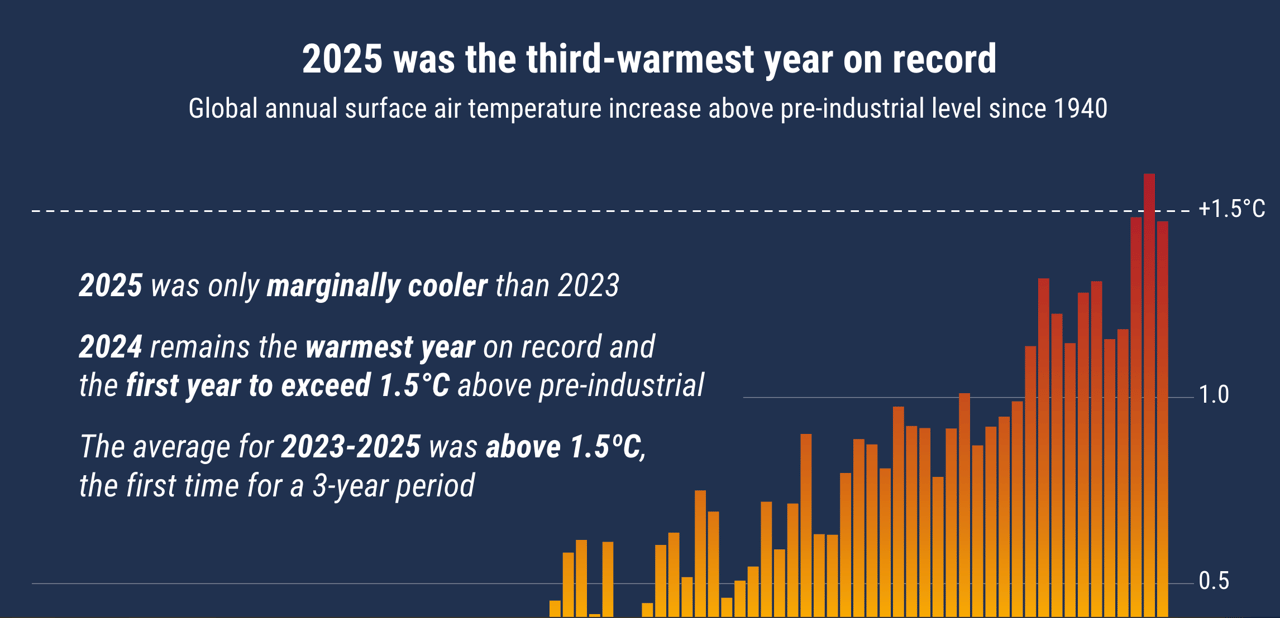
The past 11 years have been the warmest ever recorded, with the last three years marking the first period in which global temperatures exceeded 1.5°C (above pre-industrial levels), according to data published Wednesday (14 January) by the European Centre for Medium-Range Weather Forecasts (ECMWF) in the UK.
While the data for Europe suggests that regulations have achieved a significant impact, the general outlook is not positive: European green policies are facing rollbacks and the US is leaving the UN Framework Convention on Climate Change, the treaty that underpins international climate talks.
The year 2025 ranked as the third warmest on record, trailing only 2024 and 2023.
While 2025 was 0.13°C cooler than 2024 — the hottest year in recorded history — scientists emphasise this does not signal a reversal of the warming trend.
"You always have ups and downs ... There are these variations, but these variations are superimposed on a warming trend that is extremely clear," Carlo Buontempo, director of the Copernicus Climate Change Service, told journalists on Tuesday (14 January).
"I think the real message is that the last three years together are the first three years above 1.5°C. That's quite strong," he added.
The ECMWF research centre serves EU member states and 13 cooperating countries.
It plays a key role in Copernicus, the EU's program for Earth observation and monitoring, which provides everything from daily weather forecasts to long-term climate data.
The polar regions experienced particularly dramatic warming in 2025, according to its findings.
Antarctica recorded its hottest year in history, while the Arctic saw its second-warmest year on record, according to the ECMWF data.
The three-year average global temperature between 2023 and 2025 also exceeded pre-industrial levels (1850-1900) by more than 1.5°C.
Passing this degree threshold, established in the 2015 Paris climate agreement, represents a critical marker.
While individual years exceeding this limit don't mean the Paris target (which is measured by long-term warming trends) has been permanently breached, the data suggests that milestone could arrive much sooner than anticipated.
At the current pace of temperature increases, sustained long-term warming could reach 1.5°C before 2030, the ECMWF said - more than a decade earlier than projections made when the Paris accord was adopted.
Crossing this threshold permanently risks triggering more severe climate impacts, including increased extreme weather events, such as wildfires or droughts and accelerated melting of polar ice caps, with cascading effects on global climate patterns and sea levels.
In 2024, wildfires have already burned a forest area greater than England, according to The Guardian -an area that could drastically increase in the coming years.
Become a subscriber and support EUobserver's journalism in 2026.
Author Bio
Hannah Kriwak is a junior reporter from Austria at EUobserver, covering European politics.
Related articles
Tags
Author Bio
Hannah Kriwak is a junior reporter from Austria at EUobserver, covering European politics.